
Innovation Meets Scale: India’s Hybrid Approach to Clear Vision
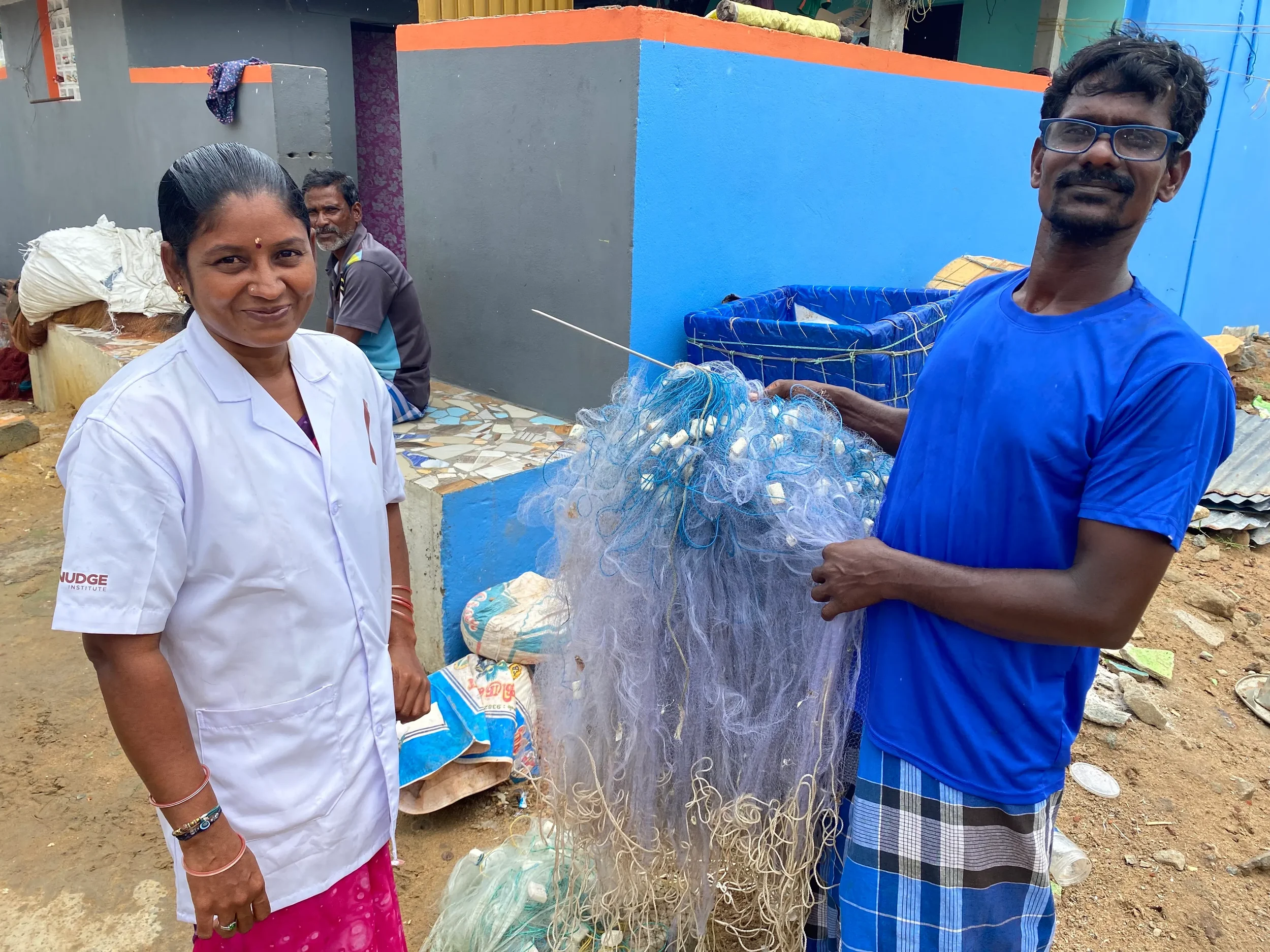
"After getting positive feedback from one fisherman, I sold around 20 pairs of glasses to 20 other fishermen."
Padmavati, an eyeglass entrepreneur in Tamil Nadu, knew fishermen in her village spend their nights at sea and their days sleeping, leaving little time to visit hospitals or eye camps. For many, eye health simply isn’t a priority. But when one man tried on his new glasses and found he could mend his nets with ease, word spread quickly. Soon, dozens of his peers followed.
Presbyopia, the gradual loss of near vision that comes with age, affects more than 300 million Indians. For tailors threading needles, farmers sorting seeds, teachers grading papers, or women cooking over dim stoves, it blurs daily life and chips away at livelihoods. The fix is simple: a pair of near-vision glasses costing as little as ₹200–₹300 ($2-$3.50). And yet, despite the simplicity, most people who need them still go without.
That is beginning to change. The Livelihood Impact Fund (LIF) is working with partners across India to rewrite the story, bringing near-vision glasses within reach of millions. Its partner, The/Nudge Institute, is spearheading efforts to integrate glasses distribution into existing community and livelihood systems, in partnership with All India Institute of Medical Sciences (AIIMS) Hospital, Aravind Eye Hospital, Dr. Shroff’s Charity Eye Hospital, Restoring Vision, VisionSpring, and state and federal governments. Together, they are laying the groundwork to address presbyopia at scale in India in the next 15 years.
What Makes It Work
A Playbook from India
India combines favorable conditions, like regulatory flexibility and vast community networks, with on-the-ground pilots led by The/Nudge Institute and partners. Several factors are emerging as particularly important for success:
Policy and regulation: Eyeglasses are over the counter in India, meaning trained community cadres and entrepreneurs can legally screen and dispense near-vision glasses.
Government investment: India spends $150 billion per year on welfare and livelihood programs, which can be leveraged to integrate presbyopia correction.
Existing networks: India has nine million Self-Help Groups (SHGs), one million Accredited Social Health Activists (ASHAs), and over 500,000 Village Health Councils (VHCs) or affiliated organizations already embedded in villages, who serve 300 million people and can take on awareness-raising and distribution.
Active Experimentation: To reach hundreds of millions of people, India cannot rely on a single delivery channel. The/Nudge is piloting two complementary models for distributing eyeglasses: one rooted in government systems, and the other built on local entrepreneurship. Each works in a different way, and together they offer a path to both scale and sustainability.
Community cadres = the engine reaching hundreds of millions of Indians: ASHAs, SHG leaders, and rural development workers already visit households and hold village meetings; adding presbyopia screening/distribution to their workflows is low-marginal-cost, trusted, and programmatically stable. Cadres are excellent for broad, repeatable coverage, but they’re tied to fixed geographies and have limited time/incentives for rapid iteration.
Entrepreneurs = the learning lab: Because customers are paying (and can say no), entrepreneurs get faster and richer feedback than clinic or camp models. They test pitches, timing, product choices, and price points. Their livelihood depends on what works. With basic tools (such as scooters), they can cover larger catchments and sustain themselves through sales.
The two models are designed to interact. Community-level workers extend reach to households that cannot pay, ensuring equity and saturation. Entrepreneurs push innovation by experimenting in the market, uncovering insights that can later be codified and handed back to cadres or government systems. Over time, this feedback loop creates a hybrid system where scale and learning reinforce each other.
Entrepreneurs in particular have become The/Nudge’s learning lab. Because they face rejection and must convince skeptical buyers, they uncover nuances that would otherwise be missed. In practice, this has already led to:
New product choices (such as bifocals becoming the frame of choice).
Credibility cues (like lab coats) that make sellers more trusted.
Contextual adjustments (price point trials, timing outreach for when villagers are actually home).
Learning library for sales (using short videos of successful sales pitches and customer interactions).
These innovations didn’t emerge from top-down planning. They surfaced because The/Nudge gave entrepreneurs the autonomy to test, fail, and adapt, then codified their lessons into standard operating procedures. That experimental spirit is what sets The/Nudge apart, and why its hybrid playbook is uniquely suited to India’s challenge.
Demand
Overcoming Cost and Stigma
Demand is not only about whether people need glasses—millions recognize they do—but also about whether they realize that the solution is both simple and affordable.
Amit Gupta, COO of the The/Nudge, explained that the real gap is not awareness of vision problems, but cost perception: “There isn’t as much lack of awareness around the problem as we think there is. The lack of awareness is regarding how cheap the solution is.” Still, even when people understand the price, adoption is not automatic. Stigma and skepticism remain powerful barriers. Some worry glasses will make them look old, and others doubt that such a simple product can really help. As entrepreneur Padmavati observed, “Most of the questions are regarding how these glasses will help. Will my presbyopia vanish soon after I start wearing these glasses? Or, will it be useful for my cataracts without surgery?”
→ Create an “aha moment” on the spot to overcome skepticism.
Ankur Sanghai, head of the entrepreneur model, emphasized the power of immediacy: “Glasses need to be offered then and there because that ‘aha’ moment has just happened.” Demonstrations at the doorstep or in village gatherings can flip doubt into conviction, with people often buying on the spot once they experience clear vision for themselves.
→ Trust is the critical bridge from awareness to adoption.
Once people see someone they know benefit from glasses, hesitation quickly fades. As entrepreneurs like Mageswari have noted: “if one person buys the glasses, another person will feel that they can also buy them because it’s trustworthy.”
→ Group settings accelerate social acceptance.
Group interactions help overcome doubt and can cause a ripple effect of demand. When people see their neighbors trying on glasses, it normalizes adoption and sparks conversations that reinforce trust. Entrepreneur Nithya has also seen this dynamic at work: “I am able to sell more glasses quickly when I gather people in one place.”
Demonstrations in shared spaces reduce stigma, make adoption visible, and create social proof that glasses work.
Affordability then anchors demand. Pilots show that once people trust the solution and see its benefits, they are willing to pay modest amounts. In Karnataka, 90% of people who received glasses in early pilots were still using them months later, with most saying they would pay ₹200–₹500 for a replacement pair, the median being ₹350.
→ Once glasses are trusted and accessible, price becomes less of a barrier.
Sustained use and willingness to pay suggest that affordability, coupled with trust, makes demand self-reinforcing.
Distribution at the Last Mile:
Getting Glasses on Faces
Reaching people isn’t just about awareness; it’s about solving for distance, mobility, and timing so that screenings and sales actually happen.
The challenge is reaching scattered villages, working around transport constraints, and ensuring a steady supply of the right products. Entrepreneurs and cadres are proving it can be done, but the logistics at the last mile shape how sustainable and scalable the model can be.
Mobility is a major constraint. Without a scooter, entrepreneurs like Nithya often rely on walking or lifts from strangers, wasting time and creating safety risks. She explained, “There’s a lot of time wasted in travel. If I can reach a particular location in half an hour, it’s good, but without a bike, it might take one and a half hours, because I have to get a lift. It’s also not very safe with some people who might offer a lift. In two ways, it’s difficult. I want to buy my own scooter, after two months when I save money from this.”
By contrast, community cadres are rooted in their own villages, so they don’t face the same mobility barriers. Leveraging cadres for local saturation and entrepreneurs for wider catchments shows how the two models can complement each other.
Time and availability limit outreach. For entrepreneurs in India, the clock is often the biggest obstacle. Many rural residents leave home early for work and don’t return until evening, making it difficult to reach them during the day. Padmavati and Nithya both described waiting until dusk when people finally gathered back in their villages, or experimenting with early mornings to catch farmers before they left for the fields.
Stock must be simple, professional, and aligned with user preferences. Carrying the right range of diopters in a standardized kit helps entrepreneurs build credibility and reduce frustration. Even presentation matters: Nithya noted that switching from a plastic bag to a more professional-looking bag improved how seriously people took her work. Similarly, The/Nudge introduced white lab coats for entrepreneurs, which gave them both confidence and authority in the eyes of customers. Just as important is offering the products people actually want. Bifocals are strongly preferred. Entrepreneurs reported that bifocals sell better than single-lens glasses because they’re more comfortable, fashionable, and easier for first-time users. As Nithya explained, many people find single-lens glasses awkward to wear, while bifocals feel natural and can be used all day.
Partnerships and Policy
Unlocking Scale Through Government Systems
While it is important to demonstrate the value of glasses, the greater challenge in India is embedding distribution within existing government and community systems. The/Nudge Institute has made this its core strategy, positioning presbyopia as a livelihood issue rather than a narrow health problem.
→ Reframing presbyopia as a livelihood issue unlocks larger funding streams.
As Amit Gupta explained: The government’s “Livelihood and poverty alleviation [programs] alone account for about $20 billion a year. All of a sudden, your pool of the pie is not $100 million; it’s $20 billion.” By moving presbyopia out of the narrow frame of public health, where budgets are constrained and priorities like cataracts and blindness prevention take precedence, advocates can tap into much larger social welfare and rural development budgets. This makes presbyopia correction relevant not just to health ministries, but to departments of rural development, social justice, and women and child welfare, all of which have incentives to improve productivity and reduce poverty among their constituencies.
→ Strong institutional partners give the effort credibility.
India’s eyeglasses pilots are backed by some of the country’s most respected eye health institutions–AIIMS, Aravind, and Shroff’s–who bring clinical credibility, training capacity, and operational reach. Global supply partners like RestoringVision and Essilor add procurement expertise and scale, while state governments provide the public systems through which distribution can expand.
→ Community cadres make government schemes practical.
India already has one of the largest grassroots workforces in the world: 9 million self-help groups representing 100 million women, close to a million ASHAs, nearly 900,000 nurses and midwives, and around 200,000 community health centers. As Amit Gupta explained, “There’s a vast community that already works with these villages day in and day out. They have the trust and they have the intent to serve that society.” Adding presbyopia screening and glasses distribution to their existing roles requires only minimal training, but leverages their scale and credibility. For governments, this makes it possible to integrate presbyopia correction into welfare schemes at very low marginal cost, reaching millions quickly without building parallel systems.
→ Implement digital verification systems to remove distribution bottlenecks.
Although glasses are not medicalized in India, many government schemes still require a doctor’s prescription, creating bottlenecks in a country with only 8,000 optometrists. As Atul Satija, CEO of The/Nudge Institute explained, this rule is less medical than fiscal, designed to prevent misuse of free schemes. Advocates are now working with ministries to replace prescriptions with digital verification, capturing Aadhaar IDs, age, and location through simple apps to ensure accountability without over-reliance on clinical staff.
Conclusion
Scaling with System Already in Place
India is not an easy place to scale a health intervention. Villages are scattered, transport is slow, and stigma still lingers in some communities. Yet the country has two unique advantages: vast community networks already embedded in rural life, and government ministries with large welfare budgets that can integrate presbyopia correction into their mandates. These are powerful foundations to build on.
This work is progressing because of the range of actors involved. Government champions can unlock policy and budgets. Community cadres extend trust and access, adding glasses distribution onto their established roles within households and villages. Entrepreneurs extend reach and ownership, treating glasses as their livelihood and, when supported with transport and tools, covering larger clusters of villages than cadres can. And partners like AIIMS, Aravind, Shroff’s, and VisionSpring ensure technical credibility and training. Together with The/Nudge Institute, they are codifying models that can scale across India.
India is proving that clear vision can be delivered at scale when simple tools are connected to big systems. Success will depend on a few essentials:
Political will and policy adjustment to streamline prescription-free delivery.
Leveraging existing networks (SHGs, ASHAs, and rural development workers) to bring glasses into households.
Simple, standardized tools to make distribution efficient and repeatable.
Modest, targeted funding to strengthen last mile delivery and ensure mobility for entrepreneurs.
Shared learning from pilots in Karnataka, Rajasthan, Uttar Pradesh, and other states to codify standard operating procedures for national scale.
Clear vision is a basic need. India is showing that with the right mix of leadership, partnership, and practical strategy, even complex systems can deliver it sustainably and at scale.