
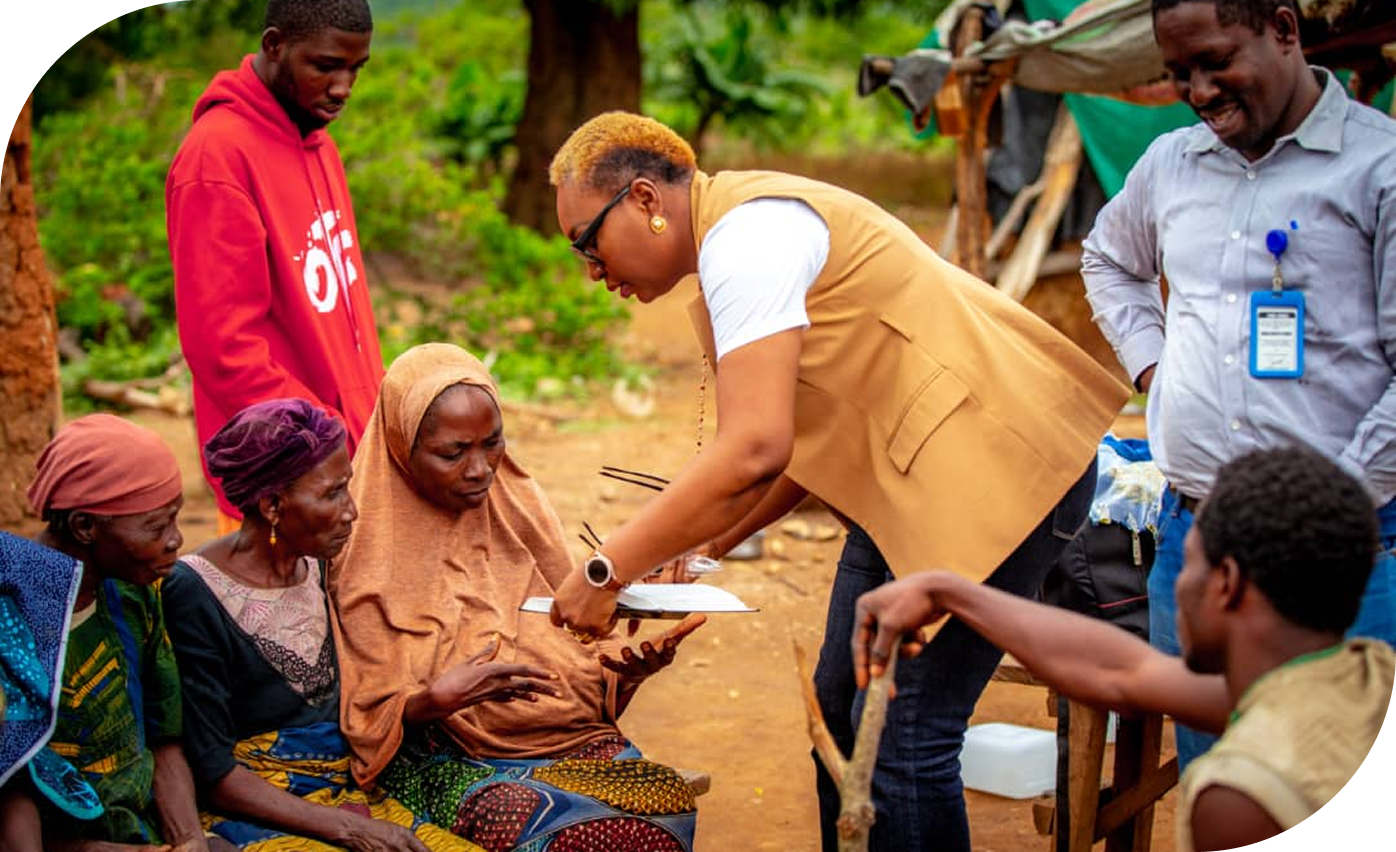
"Now my stress is over."
This is what James, a 47-year-old carpenter in rural central Nigeria, said after receiving a new pair of near-vision glasses. His previous pair had broken on a construction site, and for over a year he suffered from headaches as he squinted through his work. Like millions of Nigerians over forty, James was silently struggling with presbyopia—a condition that blurs near vision and dims daily life.
The solution isn’t high-tech or expensive. It’s a simple pair of reading glasses. Yet for decades, glasses have remained out of reach for most, due to poor infrastructure, limited awareness, and unaffordable costs. Now, a bold initiative is rewriting that story, bringing together local nonprofits, government champions, and community mobilizers to ensure that no one has to live in the blur. The Livelihood Impact Fund (LIF)—which works to meaningfully and durably improve the lives of the working poor—is addressing this problem across 16 countries with 27 partners, including several partners in Nigeria who are aiming to solve this issue at scale.
LIF’s target in Nigeria is ambitious: putting near-vision glasses on the faces of five million people over the next few years. But LIF’s partners on the ground are on target to make it happen, thanks in large part to a massive influx of glasses supplied by RestoringVision. In the last decade alone, they’ve given out over 34 million pairs of high-quality glasses worldwide. And crucially, they’ve helped build the political will, supply chains, and capacity to make that happen, country by country.
The Nigerian context for the presbyopia problem is unique: the President has publicly launched a campaign to enable access to readers, regulation poses little impediment, and there’s a high demand for reading glasses among those who need them. Despite recently having an operating budget of just $35,000, the Ministry of Health’s National Eye Health Program (NEHP), under the vibrant leadership of Dr. Oteri Okolo and her small but muscular team, has the drive to expand access to near-vision glasses nationwide.
The challenge is distribution. High inflation has made even small expenditures difficult for most Nigerians. And many regions are hard to reach due to bad roads and security concerns.
What Makes It Work
A Playbook from Nigeria
The demand for near-vision glasses is clear. Nearly 26 million Nigerians suffer from presbyopia, with the vast majority–over 22 million–lacking the glasses that correct it. Yet Nigeria benefits from multiple factors that make presbyopia screening and glasses distribution easier.
The regulatory environment has recently become favorable, with champions in government leading the way.
Anyone can screen and dispense reading glasses.
Perceptions of eyeglasses tend to be positive, associated with education and affluence.
There is strong government engagement in presbyopia correction, and President Bola Ahmed Tinubu champions eye health initiatives.
The Nigerian government is integrating eye health into the primary health-care system to make the program sustainable.
The government partners with two non-profits to screen for presbyopia and dispense reading glasses: the Christian Health Association of Nigeria (CHAN) which specializes in hard-to-reach rural areas, and the Clinton Health Access Initiative (CHAI), which implements the NEHP’s program mainly in urban areas.
CHAN’s network reaches 40% of Nigerians
CHAI works closely with the government to scale a myriad of health interventions.
NEHP coordinates all eye-health activities across Nigeria.
Currently there is little private sector engagement in presbyopia screening or correction, although a private sector partner is preparing to enter the market. There is little apparent resistance among medical professionals toward non-professionals screening for presbyopia and dispensing reading glasses.
Demand
Mobilizers with Megaphones
Demand is a question with several layers: Do people know they need reading glasses? Will they pay for them? And will they use them?
Advocacy is critical to generating demand. CHAI and CHAN dedicate time and resources to cultivating relationships with state and local governments and with community and religious leaders to generate excitement and commitment to the presbyopia initiative. And nothing beats meeting stakeholders in person.
→ Invest in relationship-building and advocacy, up front and intentionally, to create demand and support distribution.
In Nigeria, people want reading glasses once they learn about them. CHAN and CHAI build awareness through community mobilizers, who spread the word by megaphone or knocking on doors, often with the aid of music and catchy slogans. CHAI uses government-employed mobilizers who live in the communities where they do outreach. CHAN focuses its outreach on religious leaders who play outsized roles in their communities, as well as volunteer mobilizers.
→ Use trained, community-based cadres to raise awareness of presbyopia and mobilize community members for screening. This will support demand for reading glasses.
Affordability limits demand for replacement glasses. Inflation and instability mean that there will always be some people who will need access to free glasses. But CHAN, recognizing that a paid model is crucial to the sustainability of the program, manages expectations by informing recipients of free glasses that they may have to pay for their next pair. Given the great value glasses offer for livelihoods, CHAN estimates that all but the neediest Nigerians with presbyopia would be willing to pay around a dollar for a new pair. And a new player has joined the effort to combat presbyopia in Nigeria: Maisha Meds, which has established one of the largest digital networks of private pharmacies in Africa, is right now launching a paid, subsidized model of reading glasses distribution in Nigeria’s pharmacies.
→ Dispense the first pair of reading glasses at no cost, and subsidize the cost of future pairs.
→ Prime the market so people know they will have to purchase replacement glasses.
Supply, Distribution, and Logistics:
Getting Glasses on Faces
Implementers in Nigeria say that they’re ready to scale nationwide, but supply is sometimes holding them back.
There’s a tough balance to strike when scaling the distribution of reading glasses: streamlining the supply chain while ensuring that everyone is served. Reading glasses come in five different powers, known as diopters, and the government has prioritized making all five diopters available. The challenge is that, while there is demand for all diopters, carrying the full range means more inventory to purchase, transport, and distribute, which creates additional cost and logistics burdens. High demand for low diopters in Nigeria has, at times, caused CHAN and CHAI to run short on supply.
→ Ensure adequate supply, especially for lower powers that have the highest level of demand.
→ Encourage coordination and cooperation among implementing organizations. This will increase the cross-pollination of ideas and strengthen relationships so that they can negotiate with suppliers as a group to increase their purchasing power.
In Nigeria, transportation difficulties—long distances, security concerns, and bad roads—are the biggest distribution barriers for screen and dispensing. Another challenge is creating efficient logistics for screening and dispensing events so that they can be set up easily, using standardized placements and processes.
→ Hold a standing monthly meeting for all implementers to strategize, share best practices and resources, and develop negotiation strategies for supply.
→ To support sustainability, integrate the glasses initiative into primary care, and use health facilities to screen and dispense glasses. But reaching out to communities that have no access to facilities is critical to scale.
→ Streamline screening and distribution events by creating practical, on-site diagrams and guides that implementers can use.
Personnel
Staffing and Stipends for Scale
Adequate staffing is another obstacle to scale—which targeted funding could help surmount.
The lead implementers from CHAI noted that no one in their organization is devoted exclusively to presbyopia. Everyone in their office must divide their attention between many different health interventions. And during a field visit by Solutions Insights Lab in March 2025, CHAN learned that their volunteer workers weren’t getting large enough stipends to cover their basic travel expenses for mobilizing, screening, and distribution. In response to this finding, CHAN nearly tripled the volunteers’ stipends—a small amount in US dollars that had a huge impact on what gets done. They’ve also been fine-tuning their outreach strategy so that the volunteers get bigger results in fewer trips.
→ Fund dedicated staff that can give their exclusive attention to the presbyopia problem on the ground—where the most important insights happen.
→ Keep close track of what implementers need to be most effective in their work. Even small adjustments can have a big payoff.
Conclusion
Scaling Despite Difficulty
Nigeria is not an easy place to scale a health intervention. Long distances, bad roads, security risks, inflation, and tight public budgets all make logistics complex and impact uneven. But implementers are passionately committed to the work. Recipients are deeply grateful for the help. And the presbyopia initiative is reaching many thousands of people each month, across rural and urban areas, with support from government, community actors, and global health partners.
This is working. And it’s working because of the diversity of actors involved. Government champions provide legitimacy. Faith-based and grassroots organizations enable access where the formal system can’t reach. And by collaborating across models—urban and rural, centralized and community-led—we’re learning what works, what scales, and what sustains.
“If Nigeria can do this effectively through many different distribution partners and many different channels, both public and private sector, I don’t know what could hold back other countries from replicating this model,” says Abigail Steinberg, Executive Director of LIF’s Vision Action Fund.
This can be done elsewhere. But success depends on assembling a few essential building blocks:
→ Political will and regulatory flexibility to support task-sharing and community delivery.
→ Local implementers who know the terrain—literally and socially.
→ Simple tools and logistics that make distribution easy and repeatable.
→ Modest, targeted funding to unlock volunteer effort and keep supply moving.
→ Shared spaces—like monthly implementer meetings—for coordination and course correction.
If you’re interested in replicating or adapting this model, we’re happy to share resources, frameworks, and training materials. We can also connect you with key partners—such as CHAI, CHAN, and the National Eye Health Programme—who bring deep experience from the field.
Clear vision is a basic need. Nigeria is proving that, with the right mix of leadership, partnership, and practical strategy, even complex systems can deliver it—at scale.