
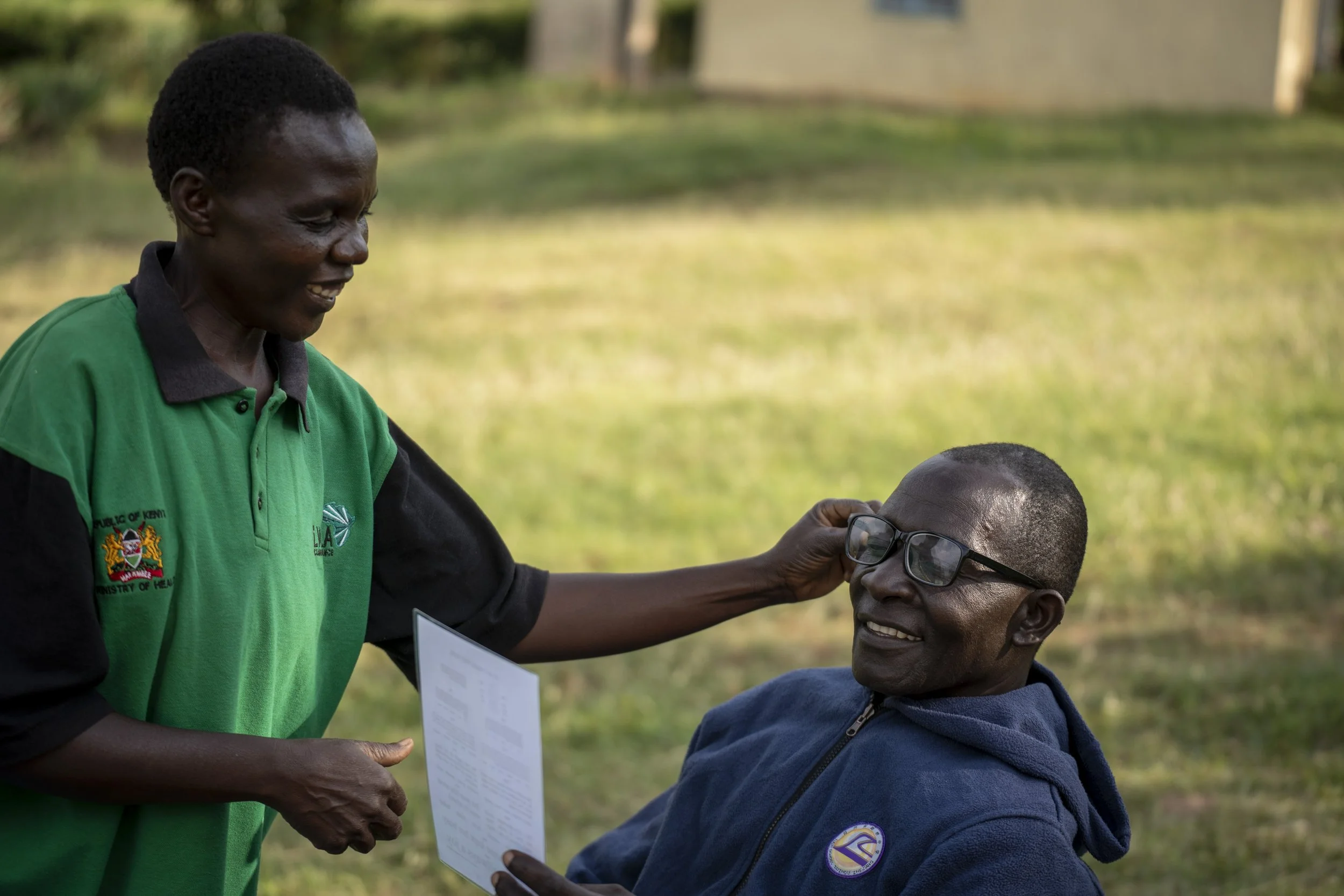
Homa Bay, Kenya, August 13, 2026—Kenyans in Homa Bay and Meru will soon gain access to near vision glasses. A new initiative that aims to advance Kenya's Universal Health Coverage goals and improve Kenyans’ health, well-being, and livelihoods through improved access to vision care launched today. Beginning in Homa Bay and Meru counties, the initiative integrates basic eye care and the distribution of reading glasses into community and primary healthcare, bringing services closer to communities. The pilot phase aims to reach a quarter of a million people with near vision eyeglasses–including 150,000 people through primary healthcare and Community Health Promoters in Homa Bay and Meru counties and another 100,000 through partners in additional counties–before expanding further. The event took place at Nyalkinyi Health Centre, where H.E. Gladys Wanga, Governor of Homa Bay County, officially launched the initiative, alongside Hon. Grace Osewe, County Executive Committee Member for Health, Dr. Kevin Osuri, the Chief Officer of Health, and other dignitaries.
Most adults over 40 require reading glasses due to presbyopia, an age-related near-vision impairment, affecting 1.8 billion people globally. The solution is simple: a pair of ready-made reading eyeglasses that cost around KES 130 to manufacture. However, in Kenya, around 7 million older adults have presbyopia, and the majority, around 85% , cannot access glasses. Barriers include prohibitive cost, lack of awareness, poor physical access, and uneven human resources. That leaves millions of Kenyans living with a near-vision impairment which is easily correctable, affecting not only their health and well-being, but also their work and livelihoods.
Under the leadership of Ministry of Health and Council of Governors and supported by Lwala Community Alliance, The Coalition for Clear Vision, and Vital Strategies, with funding from Livelihood Impact Fund, the initiative trains all healthcare workers at levels 1-3 in Homa Bay and Meru to provide basic vision screening and to refer patients for further care as needed. Community Health Promoters (CHPs) play a critical role, screening individuals at the household level and referring those who need eye glasses or additional care. Patients with near-vision impairment receive ready-made reading glasses on-the-spot at primary care facilities (levels 2–3) and other dispensing locations. Nearly all of Homa Bay's 3,000 CHPs have been trained, with training to commence in Meru in September 2026.
The impact reaches beyond near-vision. Reading glasses have been shown to increase productivity and income by up to 30 percent. They help people perform their near-vision tasks safely and accurately, and can help prevent people from leaving the workforce early due to near-vision impairment.
“This work gives us a chance to understand what it takes to make vision care work well within the health system. Working with government, donors, partners, health workers and communities, we are testing what works in practice and how to make it a lasting part of care. How do we demedicalize and democratise access to eyewear for near vision impairment? These lessons can help shape how vision care is delivered in other parts of Kenya,” said Kenneth Ogendo, Director of External Affairs, Policy, Advocacy & Partnerships, Lwala Community Alliance.
“Today marks an important step towards ensuring that more people in Homa Bay can see better, work better and live better. Let us use this programme to bring eye care closer to our communities, strengthen our public health facilities, empower our frontline health workers, increase awareness and ensure that no person is left behind because of an avoidable and correctable vision problem”, said Dr. Mutakha Kangu, who represented the CEO COG Mrs. Mary Mwiti, EBS at the launch.
"Millions of Kenyans are living with one of the most correctable problems in health that has a cost-effective solution, affecting not only their vision, but also their work, income, and independence," said Abigail Steinberg, Executive Director of Vision Action Fund, Livelihood Impact Fund. "By weaving care into community health services that people use close to home, Homa Bay and Meru are showcasing a replicable model that can close the vision gap in Kenya.”