The $1.50 intervention that’s driving uptake for primary health care
Opinion: Near-vision glasses aren’t just an eyesight fix — they offer a window into a larger shift toward demand-driven health systems, where high-uptake services draw people into care and connect them to broader screening and treatment for noncommunicable diseases.
By Rollo Romig, Abigail Steinberg //06 May 2026
As health ministers gather in Geneva later this month for the World Health Assembly, noncommunicable diseases, or NCDs, are high on the agenda. So is the perennial challenge of strengthening primary health care, particularly in low- and middle-income countries where community health workers are the backbone of the system. Yet one widespread condition with a remarkably low-cost treatment is likely to be overlooked: presbyopia. This age-related loss of near vision affects an estimated 1.8 billion people globally.
That omission matters. Near-vision glasses are not a niche eye-care intervention. They point to something much bigger: a shift from health systems that push services toward communities to ones that respond to what people actively seek. With the right approach, they can draw people into primary care, build trust in community health workers, or CHWs, and open doors to screening for other NCDs. We’ve seen the proof in Ethiopia.
In dozens of interviews we conducted in Ethiopia earlier this year with community health workers, program managers, government officials, and glasses recipients, a consistent picture emerged: When CHWs are equipped to screen for presbyopia and distribute near-vision glasses, something bigger happens. People who had never sought care from their local health post start showing up. And when they do, they can be screened for hypertension, diabetes, and other conditions they didn’t know they had. Since October 2025, more than 275,000 people have been screened under the program. Over 159,000 received reading glasses, and nearly 45,000 were referred for additional services.
“After the eyeglass screening and distribution, members of the community who had previously shied away from us began coming for other health services,” said Derartu Ahmed, a health extension worker in Harar, Ethiopia. People who came in for glasses were connected to cervical cancer screening, tuberculosis treatment, diabetes care, and childhood vaccinations. Glasses were the reason they walked through the door.
What’s happening in Ethiopia reflects a broader shift underway in global health. As financing tightens and expectations rise, systems can no longer rely on pushing standardized services and hoping people show up. Instead, they are beginning to organize around demand using high-uptake, tangible services to draw people in and connect them to more complex care.
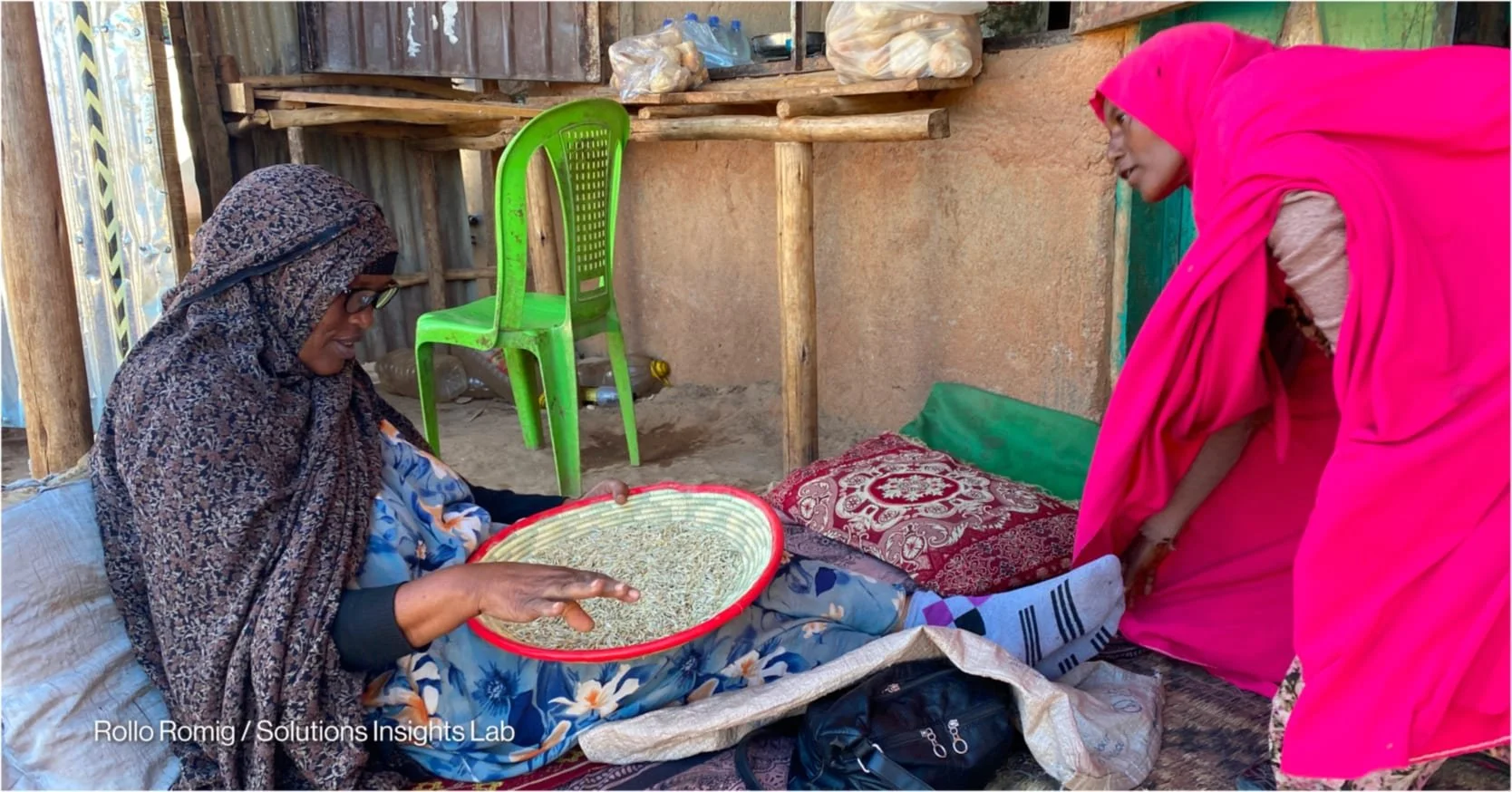
This isn’t coincidental. It reflects something structural about how presbyopia presents in communities and what near-vision glasses represent to the people who receive them. Presbyopia typically affects adults over age 40, the same population most at risk for hypertension and diabetes. Glasses are an immediate, tangible benefit to one’s productivity and livelihood: The minute someone receives them, they can read again, thread needles, sort grains, and make accurate payments on their smartphone apps. That immediacy builds trust in a way that preventive health messaging rarely can.
As one health extension worker put it, after she started distributing eyeglasses, community members began asking whether she was “working as a doctor now.” (She clarified that she was not, but used the moment to explain the full range of services she provides.)
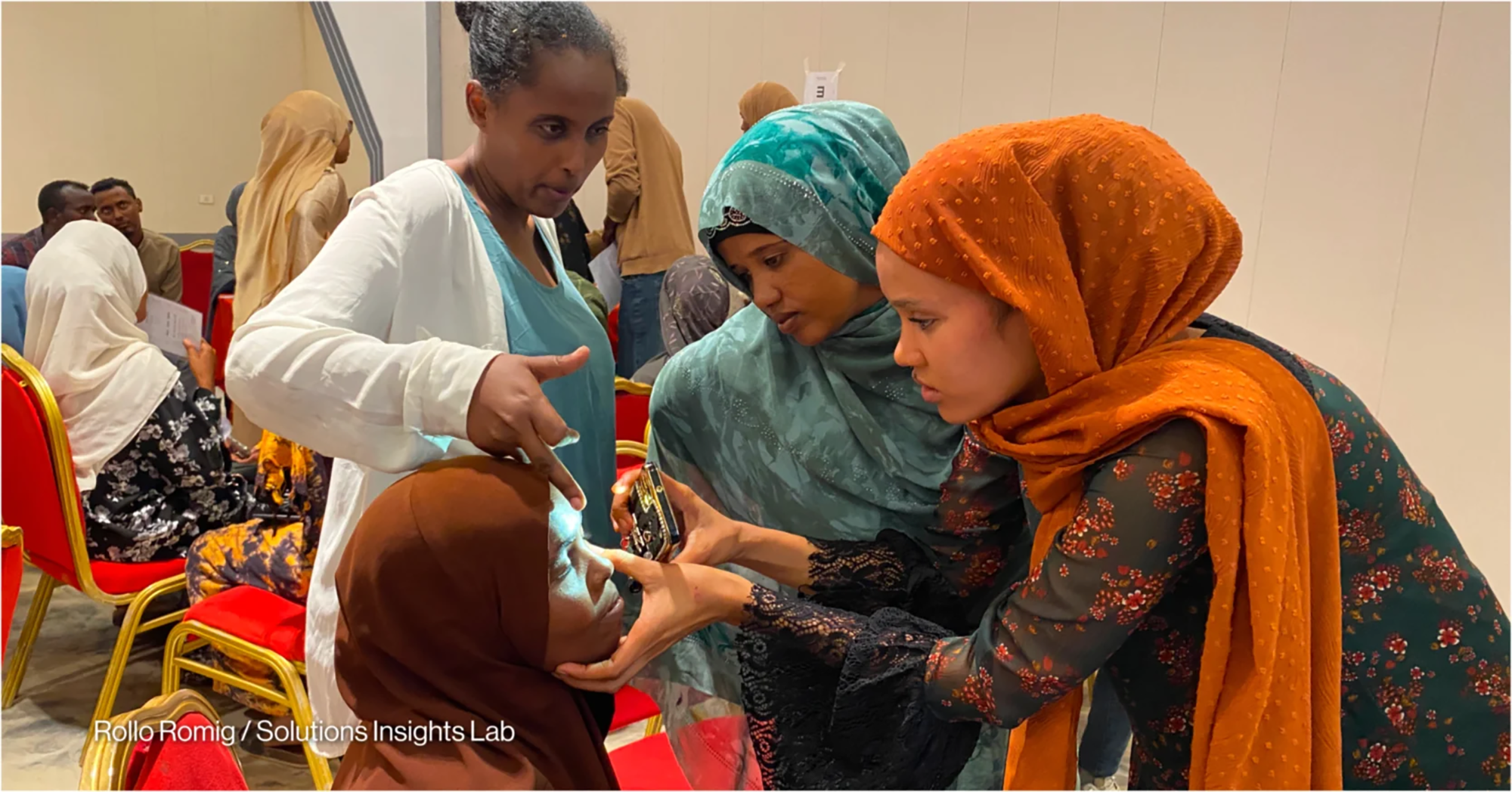
Ethiopian health extension workers receive training for vision screening. Photo by: Rollo Romig / Solutions Insights Lab
In Ethiopia, Last Mile Health, or LMH, with support from the Livelihood Impact Fund and in close partnership with the government of Ethiopia, has embedded presbyopia screening and near-vision glasses distribution into the country's existing Health Extension Program, a network of more than 43,000 salaried, government-employed community health workers operating out of health posts across the country.
Critically, glasses distribution is bundled with NCD screening: Every person who comes in for glasses is also checked for hypertension, diabetes, and other eye conditions. In the program’s opening months, roughly 1 in 4 who received glasses were referred for NCD-related care — a striking conversion rate from a single point of contact.
The program’s design reflects a deliberate logic: Do not treat near-vision glasses as a standalone product to be delivered through separate campaigns. Embed them in systems communities already use and trust, and bundle them with other NCD screenings. The result is that glasses become not an endpoint but an entry point.
Getting there took work. Importing and distributing glasses in Ethiopia required navigating approvals from multiple regulatory bodies, the Food and Drug Administration, the Ministry of Health, customs, and district officials, because glasses are classified as medical devices. LMH’s approach was to engage government counterparts early and creatively — screening and distributing glasses to officials within those agencies so they could experience the benefits firsthand. Skepticism became enthusiasm.
Supply chain logistics in a geographically dispersed country required improvisation, including motorcycle delivery and, in some areas, donkeys. Training 43,000 health workers at scale required a blended digital-and-in-person model that cut costs by roughly 40% and has since been approved by the Ministry of Health for nationwide rollout.
None of these challenges is unique to Ethiopia. But neither are the assets Ethiopia brought to this work — a large community health workforce, a network of community health posts, and the political will to integrate new services into existing systems rather than build parallel ones. Countries with similar infrastructure have a viable playbook to follow.
More fundamentally, demand-driven approaches shift power. When systems are built around what people actively seek, they move decision-making closer to patients and frontline providers and create stronger incentives for accountability and performance.
The development sector has long struggled with NCD uptake, particularly among men and older adults who are less likely to engage with preventive health services. Near-vision glasses reach exactly those populations.
They are, as health extension worker Fahmi Aliyi Tahir observed, the kind of intervention that changes how a community sees its health system. “After the screening and distribution, we have been seeing more patients coming to us,” he said. “Even if they see us on the road, they ask us when they should come and get screened.”
As WHA delegates discuss how to strengthen primary health care with constrained resources, the best question to ask is: Which interventions have multiplying effects? Near-vision glasses prompt screenings for NCDs. They build community trust in health workers. They draw in patient populations that the health system has struggled to reach. And they deliver an immediate, visible benefit that spreads by word of mouth faster than almost any health campaign can.
As global health budgets tighten, the question is no longer just what services to fund, but how to design systems that people will actually use. Interventions such as near-vision glasses don’t just deliver value on their own — they unlock demand for a wider set of services. In a constrained financing environment, that kind of multiplier effect is a necessity.
Near-vision glasses pay off far more than the $1.50 each pair costs. It’s time for funders to treat them as a gateway investment in primary care, and not a marginal add-on. The Eyeglasses Initiative shows where and how that work is already happening.
We are taking the lessons we have learned from Ethiopia and scaling them to millions of people. On May 19, during WHA79, come hear from leaders in this space and learn about a new financing opportunity for governments ready to make ambitious national commitments to expand access to vision care. Register at https://luma.com/2intdiqq or fill out an interest form here.