Livelihood Impact Fund Launches Global Vision Impact Award
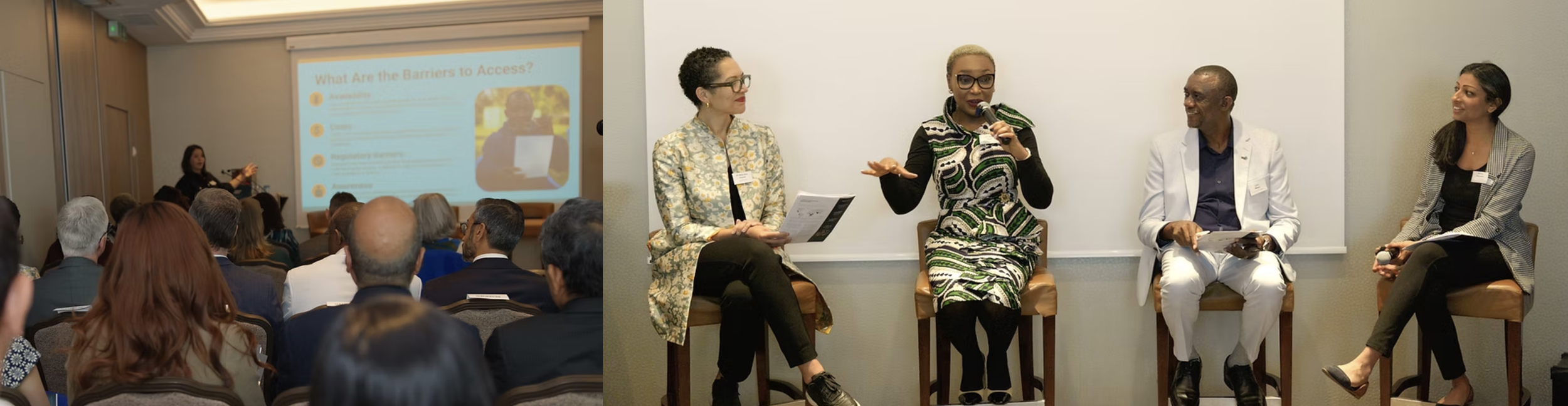
Right: Dr. Mary Ann Etiebet, President and CEO, Vital Strategies speaks with panelists Dr. Oteri Okolo, National Coordinator, National Eye Health Programme, Nigeria Federal Ministry of Health & Social Welfare; Julius Mbeya, Co-CEO, Lwala Community Alliance; and Mallika Raghavan, Deputy Chief Program Officer, Last Mile HealthGeneva, Switzerland, May 19, 2026—Today during the 79th World Health Assembly, Livelihood Impact Fund launched the Global Vision Impact Award, a transformative funding opportunity to turn one of the world’s most overlooked global health challenges into one of its greatest economic wins. Livelihood Impact Fund is seeking 15 government partners to collaborate in delivering glasses to hundreds of millions of people with presbyopia, and is collecting initial expressions of interest through a simple web form.
Age-related near-vision impairment, or presbyopia, affects over 1.8 billion people worldwide. Without access to reading glasses, 800 million people are prematurely withdrawing from their work, their craft, and their families. Left untreated, uncorrected presbyopia drains over $50 billion from low- and middle-income countries each year as a result of productivity losses. Despite its high burden, presbyopia is one of the most neglected development and global health challenges, particularly in low- and middle-income countries.
“Near-vision impairment is silently stealing sight from millions and costing economies billions — and the fix costs less than a dollar per person,” said Abigail Steinberg, Executive Director of Vision Action Fund at the Livelihood Impact Fund. “What’s missing isn’t the science or the supply. It’s the upfront capital to build a national program. That’s exactly what this award will deliver. We are excited to partner with governments around the world to help close the vision gap and deliver eyeglasses to millions of people, and are looking forward to meeting with governments interested in joining.”
Fortunately, presbyopia is one of the most solvable global challenges. It requires no surgery, no specialized facility, and no complex supply chain. A ready-made pair of reading glasses corrects the issue and costs less than $1 to make. Community workers with basic training can screen patients and distribute ready-made reading glasses at minimal cost.
Through the Global Impact Vision Award, Livelihood Impact Fund invites governments to address the gap and save their countries billions in lost productivity. The award will provide the required up-front investment, covering the short-term costs of building supply chains, training community providers, educating the public, and establishing the policy frameworks that allow near-vision care to function as a public good. Once those foundations are in place, the returns to the economy are significant: every $1 invested in eye health yields $28 in economic returns.
As part of the award, selected governments will receive:
Up-front technical assistance, capacity building, and policy design support from Livelihood Impact Fund and Vital Strategies
Catalytic philanthropic funding and private sector investment to implement policy changes and launch near-vision programs for national scale
As part of the launch, Vital Strategies, the Clinton Health Access Initiative, Last Mile Health, Lwala Community Alliance, the World Health Organization, and the International Agency for the Prevention of Blindness today joined an over-subscribed venue with the Livelihood Impact Fund and government officials from Kenya, Cambodia, the Dominican Republic, and Nigeria to spotlight how governments of Ethiopia, Kenya, and Nigeria are scaling near-vision care through their public health systems — showcasing a proven, cost-effective intervention already de-risked and ready for national adoption.
Studies demonstrate that reading glasses can boost worker productivity by more than 20% and raise individual income by more than 30%. Scaled up, low-cost interventions to address presbyopia could deliver US$1.05 trillion in global productivity gains by 2050.
"It's rare to find an intervention this simple and this consequential,” said Dr. Neil Buddy Shah, CEO of the Clinton Health Access Initiative. "A pair of reading glasses costs under a dollar to produce and can raise an adult's income by a third; restoring their ability to work, to earn, and to care for their family. The opportunity now is for governments to scale what already works."
“The Global Vision Impact Award will lead to hundreds of thousands of people living with presbyopia regaining agency and living healthier lives,” said Dr. Mary-Ann Etiebet, President and CEO of Vital Strategies. “Awarded governments will be funded to close the vision gap with long-term policy solutions and will gain enormous health and economic improvements from this simple and low-cost, transformative tool: reading glasses. We urge Ministers of Health to learn more about this opportunity."